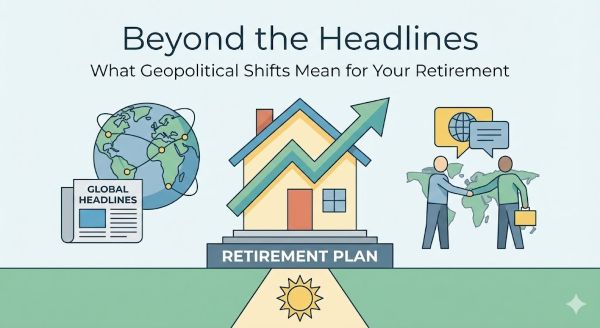
Beyond the Headlines: What Geopolitical Shifts Mean for Your Retirement
If you’ve been keeping an eye on the news lately, you’ve likely seen headlines ranging from diplomatic tensions over Greenland and NATO to significant leadership changes in Venezuela. When the "breaking news" banners start flashing, it’s only natural to wonder: What does this mean for my retirement savings?
It’s a question I hear often, especially when global events feel particularly unpredictable. My goal is to help you look past the noise and focus on what truly matters for your long-term security.
Perspective Over Panic
When we see conflict or political shifts on the world stage, our instinct is often to "do something" to protect our money. However, history tells a very different story about how markets actually react to these events.
Think of your retirement plan as your financial house. You’ve spent years building it with a solid foundation and a sturdy roof. A geopolitical event is often like a sudden thunderstorm. It might look dark and scary through the windows, and it might even cause some rattling, but a well-built house is designed to stand firm through the weather.

In looking at the data, even major events that felt world-shaking at the time—like the Iraq War or the 2023 Hamas attacks—often saw the market higher just one year later. While every situation is unique, the broader lesson is clear: markets are incredibly resilient. Short-term volatility is the price we pay for long-term growth.
The "Commodity Connection"
A lot of the recent news centers on resources—specifically oil and minerals. You may have heard about the U.S. looking toward Venezuela's vast oil reserves or the strategic importance of Greenland’s rare-earth metals.
In the past, geopolitical shocks often hurt the market by driving energy prices up (like when Russia invaded Ukraine in 2022 and oil hit nearly $128 a barrel). Today’s situation is a bit different. Increased production from places like Venezuela could actually put downward pressure on oil prices over time.
For you, as someone near or in retirement, lower energy prices can be a quiet win. It helps keep inflation—that "unwelcome intruder" in our financial house—at bay, making your monthly budget go just a little bit further.
Watching the Foundation
While geopolitical headlines grab the "clicks," I am keeping a closer eye on market valuations. Currently, U.S. stocks are trading at a premium—meaning we are paying more for every dollar of company earnings than we have historically.
When the market is "expensive" like this, it doesn’t mean a crash is coming, but it does mean we need to be extra diligent. This is where your financial fingerprint comes in. Your portfolio isn't a carbon copy of the S&P 500; it’s a specific blend of assets designed for your goals. We use diversification to build a "moat" around your nest egg, ensuring that even if one sector gets hit by a storm, the rest of your house remains protected.
Staying the Course
As your "quarterback" in this process, my job is to look at the whole field, not just the play happening right now. Geopolitical events will continue to evolve, and the headlines will likely stay loud. But your plan was built with this uncertainty in mind.
Most of these regions, while strategically important, have very little direct impact on the global financial markets. For example, Venezuela has been in default on its bonds for years, meaning your portfolio likely has little to no exposure there.
Instead of trying to predict the next headline, we focus on what we can control: your spending, your tax strategy, and maintaining a diversified mix of investments.
If these recent events have you feeling a bit uneasy, let’s chat. I’m here to help you filter out the noise so you can get back to enjoying the retirement you’ve worked so hard to build.


