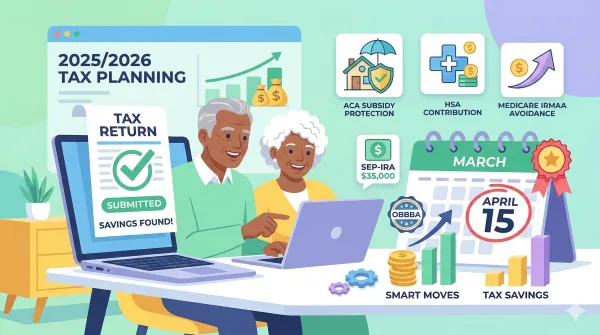
March Madness—Smart Tax Moves That Save You Money
The April 15th tax deadline is just around the corner. For some of you, the plan is to file and be done with the "madness" sometime in March. Others might be looking to sneak in just under the finish line.
Whether you’re using software to DIY your return or handing a box of records to your tax advisor because your situation has grown more complex, I want to help you shift your perspective. Think of your tax return not just as a look back at last year, but as a financial fingerprint for your future. This is a perfect time to make smart moves that save you money today and set you up for a smoother ride in 2025 and 2026.
The Return of the "Subsidy Cliff"
If you obtain your health insurance through the Affordable Care Act (ACA), also known as Obamacare, we need to talk about a potential storm on the horizon.
During the last few years, the government offered enhanced subsidies that made insurance more affordable for almost everyone. However, those extra benefits expired at the end of 2025. This means the so-called subsidy cliff is back for 2026.
If your income—specifically your MAGI—exceeds 400% of the federal poverty line, your eligibility for financial help disappears instantly.
What is MAGI? It stands for Modified Adjusted Gross Income. Think of it as your total income (AGI) with a few things added back in, like non-taxable Social Security payments.
The Single Filer Risk: In 2026, the limit is approximately $63,840. If you earn just $1 over that, you might have to repay your entire premium subsidy—which could be a bill approaching $10,000.
The Family Risk: For a household of two, the limit is about $86,560. Crossing this line could result in a repayment of up to $20,000.
It’s a painful awakening, so we must be incredibly careful with how we manage wages, dividends, and retirement withdrawals. If you're worried about where you stand, I can help you model your effective tax rate to ensure you don't accidentally fall off that cliff.
Medicare and the "Success Tax" (IRMAA)
Your MAGI doesn't just affect health insurance subsidies; it also dictates what you pay for Medicare. If your income is higher, you may be hit with IRMAA—the Income-Related Monthly Adjustment Amount. I like to think of this as a success tax on your healthcare.
For 2026, the surcharges kick in if your MAGI from two years ago (2024) was above certain thresholds:
Individuals: Above $109,000.
Married Couples: Above $218,000.
If you cross these lines, you could pay an extra $81.20 per month for Part B and $14.50 for Part D. For very high earners, those surcharges can climb much higher.
How to Lower Your MAGI and Keep Your Money
The good news is that we have several tools in the shed to help lower your income and protect your nest egg.
Traditional IRA Contributions: For the 2025 tax year, you have until April 15, 2026, to contribute up to $7,000 (or $8,000 if you’re 50+). For the 2026 tax year, that limit jumps to $7,500 ($8,600 if you're 50+).
Health Savings Accounts (HSAs): This is one of the best empty boxes you can fill. Contributions are tax-deductible, and withdrawals for medical expenses are tax-free. For 2025, you can put in $4,300 ($5,300 if you're 55+). In 2026, it rises to $4,400 ($5,400 if you're 55+).
The SEP-IRA for the Self-Employed: If you have a side business or are self-employed, the limits are much higher—up to $70,000 for 2025.
New Opportunities with the "One Big Beautiful Bill" Act (OBBBA)
A new piece of legislation called the OBBBA has introduced some beautiful new benefits starting in 2026 that we should keep on our radar:
The Senior Bonus: If you are 65 or older, there is a new deduction of up to $6,000 for singles or $12,000 for couples. This is a huge win for keeping more of your hard-earned money.
Charitable Giving for Everyone: Even if you don't itemize your taxes, you can now deduct cash donations to eligible charities—up to $1,000 for singles and $2,000 for couples.
K-12 Scholarship Credit: Starting in 2027, you can get a tax credit of up to $1,700 for donating to organizations that provide scholarships for private or religious schools.
Because these rules are constantly shifting, I'm here to act as the quarterback for your financial team. While I can't provide the final legal tax advice your CPA does, I can help you design the strategy that keeps your financial house standing strong.


