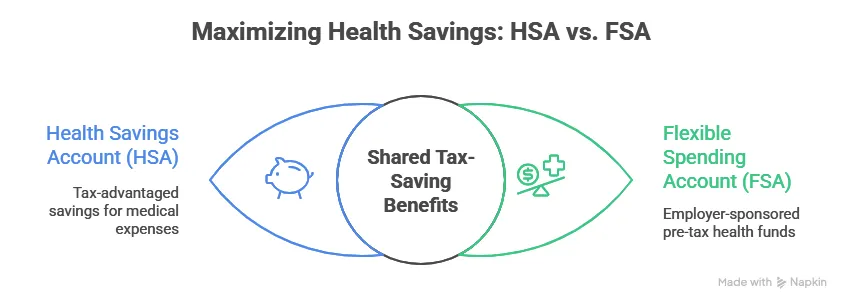
Your Open Enrollment Guide: HSA vs. FSA for 2026
It’s that time of year again—Open Enrollment. This is the short window in the fall when you get to make critical decisions about your health benefits for the coming year.
I know it’s tempting to just check the same boxes you did last year. But when it comes to your health savings, you could be leaving real, hard-dollar tax savings on the table. The two big players you'll see are the Health Savings Account (HSA) and the Flexible Spending Account (FSA).
They sound similar, but they work in very different ways. Choosing the right one for your family is a key part of smart financial planning. Let’s break them down.
The HSA (Health Savings Account): A Powerful Long-Term Tool
Think of an HSA as a 401(k) for your healthcare. It’s an incredibly powerful savings vehicle, but it has one important requirement: you must be enrolled in a High-Deductible Health Plan (HDHP).
If you have an HDHP, the HSA offers what I call the "triple tax savings," which is unmatched by any other account:
Tax-Free Contributions: The money you put in (up to the annual limit) is tax-deductible, lowering your taxable income for the year.
Tax-Free Growth: Unlike a regular savings account, your HSA funds can be invested. That money can then grow and compound over years (or decades) completely tax-free.
Tax-Free Distributions: When you pull money out to pay for qualified medical expenses (things like co-pays, prescriptions, dental, vision, and even Medicare premiums in retirement), those withdrawals are 100% tax-free.
The absolute best part? There is no time limit to spend your contributions. The money is yours, it rolls over every single year, and it stays with you even if you change jobs. Many people use their HSA as a long-term retirement-health fund, paying for today's medical costs out-of-pocket and letting that HSA balance grow for the future.
The FSA (Flexible Spending Account): A "Use-It-or-Lose-It" Plan
The FSA is a bit simpler, but it comes with one major catch.
Like an HSA, you contribute money pre-tax, which lowers your taxable income. You can then use that tax-free money to pay for medical, dental, and vision expenses throughout the year.
Here’s the drawback: The FSA has a "use-it-or-lose-it" requirement.
This means you have to spend all the money in your FSA by the end of the plan year (or a short grace period, if your plan offers one). Any money left unspent is forfeited back to your employer. This requires you to very carefully estimate your family's healthcare spending in advance, which can be difficult.
Which One is Right for You?
So, how do you choose?
An HSA is generally the superior choice if you are eligible for one (meaning you have an HDHP) and you want to build long-term savings for healthcare. If you are healthy and don't expect many medical bills, it's a fantastic way to build another tax-free nest egg for retirement.
An FSA can be a good choice if you are not eligible for an HSA (perhaps you prefer a traditional, low-deductible health plan). It's also useful if you have very predictable and high medical or dental costs (like braces) that you know you will incur this year.
An Advanced Tip: Can You Have Both?
Here’s a strategy I often discuss. In most cases, you can't contribute to a general-purpose medical FSA and an HSA at the same time.
However, many employers offer a limited-purpose FSA.
This special type of FSA can only be used for qualifying dental and vision expenses. The strategy? You can contribute to both your HSA and a limited-purpose FSA.
This allows you to:
Pay for your family's expected glasses, contacts, and dental cleanings with tax-free money from the limited-purpose FSA.
...while leaving your HSA funds completely untouched, allowing 100% of your HSA contributions to be invested and compound for the long term.
Open enrollment is a key moment to be the quarterback of your finances. Before you just check the box, take a few minutes to see if an HSA or FSA (or both!) can help you build a stronger, more secure financial house.


