Beyond the Headlines: How Market Sectors and Global Events Impact Your Retirement
When you tune into the financial news these days, you’re likely hearing about two major things: wild swings in oil prices and the ever-changing narrative around Artificial Intelligence (AI). When the market gets turbulent, it’s completely normal to feel a little uneasy and wonder, “How does this affect my retirement?”
When we talk about the stock market, we usually look at the big picture, like the S&P 500. But to really understand what's happening, we need to look one level deeper. The S&P 500 is made up of 11 different "sectors"—think of them as different neighborhoods within a large city. Each neighborhood has its own unique characteristics and reacts differently to the economic weather.
Right now, the difference between the best and worst-performing sectors is a massive 40%. Let’s break down what’s driving this and, more importantly, how we protect your financial house in the midst of it.
A Shift in the Tech Story
For the last few years, a handful of technology and AI companies—often called the Magnificent 7—have been the star quarterbacks of the market. They've driven massive gains.
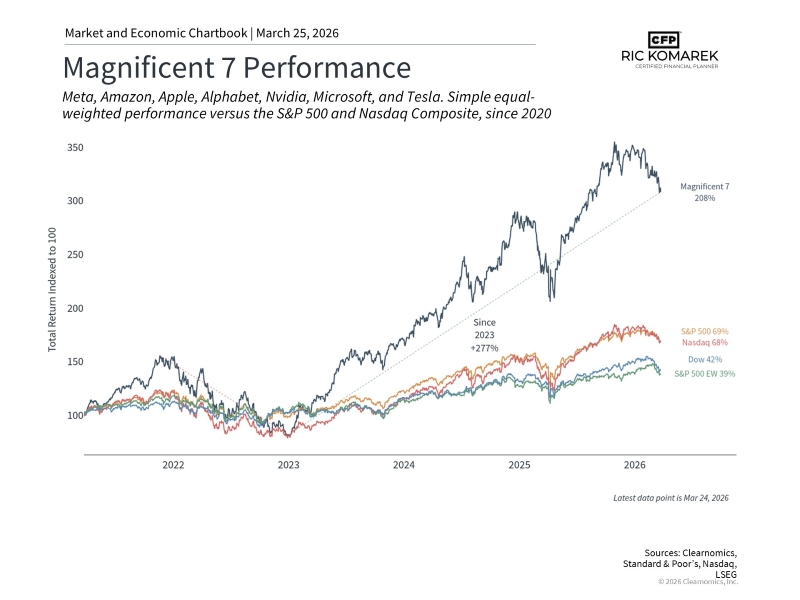
But recently, the S&P 500 experienced its first pullback of more than 5% from its all-time high. The narrative has started to shift as people ask questions about how new AI tools might disrupt traditional software companies. Whether or not these fears are fully justified, they have caused a reassessment of technology valuations.
Here is the interesting part: even with the S&P 500 pulling back, 6 of the 11 market sectors are actually positive so far this year! How does an index drop when most of its parts are growing? It is because the S&P 500 doesn't weigh all neighborhoods equally. Technology currently makes up nearly one-third of the entire index, while Energy and Utilities sit at just 3.5% and 2.5%, respectively.
This is a powerful reminder of why we never want to be overly reliant on yesterday's winners.
The Energy Counterweight
While tech has stumbled, the energy sector has surged, up roughly 30% this year. This is largely driven by a sharp rise in oil prices due to ongoing conflicts in the Middle East.
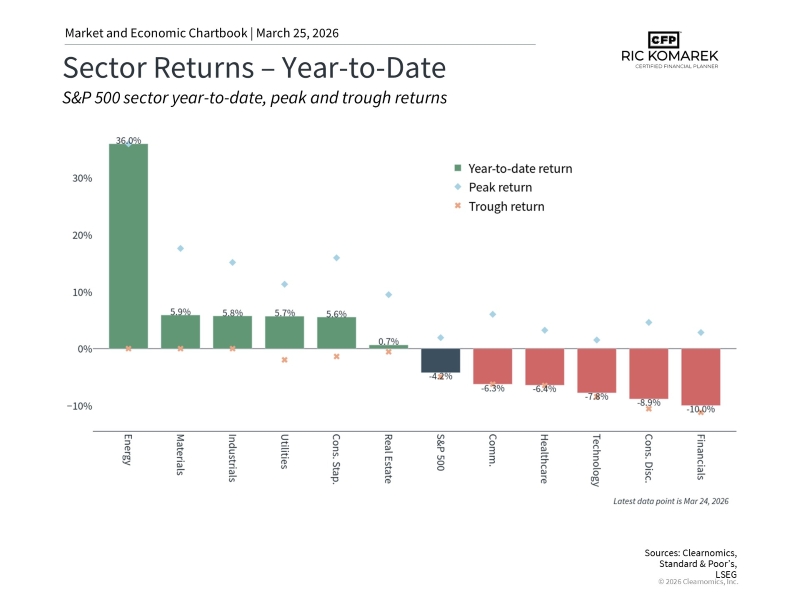
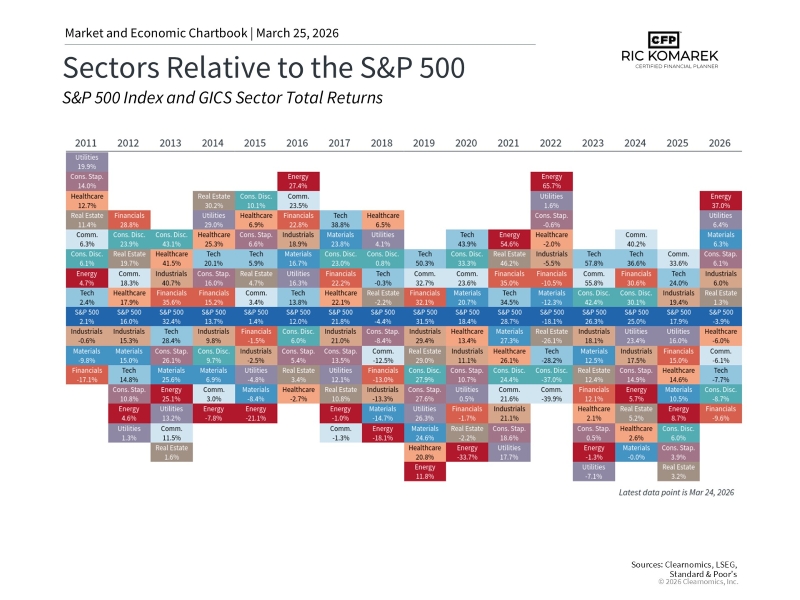
While paying more at the pump is frustrating for all of us, from an investment standpoint, the energy sector often acts as a shock absorber. During times of global uncertainty, energy stocks historically tend to rise. We saw this in 2022, and we are seeing it again now. It’s a great example of why we don’t want all our eggs in one basket.
And from a long-term planning perspective, there is reason to stay optimistic. The U.S. is now the world's largest oil producer. Because we act as a "swing producer," we can often increase production to offset global shortages, which helps moderate prices over time.
Building Your Financial Moat
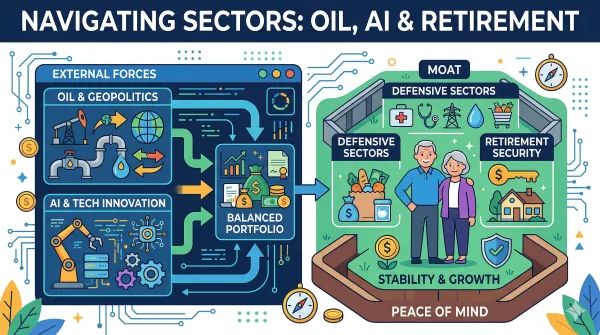
Think of all the hard work you did planning your retirement income as building a strong and comfortable financial house. You've designed it to provide shelter and support for your entire lifetime.
But even the best-built house needs protection from potential storms. When the market gets jittery about tech stocks or global conflicts, we shift our focus to building a financial moat around your nest egg. We do this by utilizing "defensive" sectors.
Defensive sectors include areas like:
Utilities: Companies that provide electricity and water.
Consumer Staples: Companies that make the everyday essentials we buy at the grocery store.
Healthcare: Medical services and products that people need regardless of the economy.
A great term for some of these steady companies is HALO: Heavy Assets, Low Obsolescence. Basically, they provide real, tangible goods and services that aren't easily replaced or disrupted by the latest computer program.
These sectors tend to be steady. Even when the economy gets rough, people still pay their light bill, buy groceries, and go to the doctor. Because their cash flows are more predictable, and they often pay reliable dividends, these companies help reinforce the defenses around your retirement income.
The Bottom Line
It is virtually impossible to predict which sector will be at the top of the leaderboard next year. The hot stock of today can easily become the laggard of tomorrow.
That is exactly why true financial security doesn't come from chasing trends. It comes from maintaining a well-diversified portfolio that includes growth engines (like tech), counterweights (like energy), and a deep, protective moat (like utilities and staples). By keeping your investments balanced across all these different neighborhoods, we ensure your financial house is built to weather any storm and support you throughout a long, comfortable retirement.


