Is Your Social Security COLA at Risk? How to “Stress Test” Your Retirement Plan
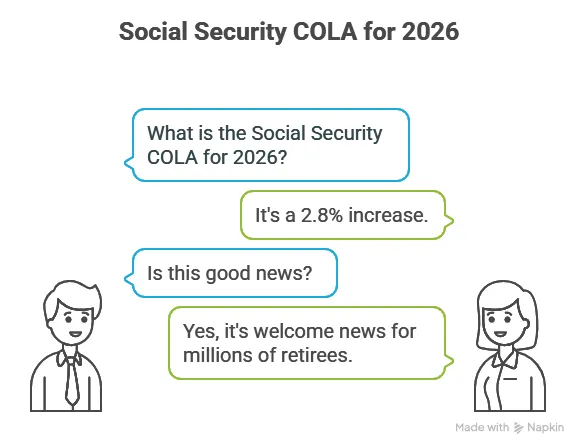
The Social Security Administration recently announced the Cost-of-Living Adjustment (COLA) for 2026, and it’s a 2.8% increase. This is welcome news for millions of retirees who rely on Social Security as a key part of their income.
Think of your Social Security benefit as the solid, reliable foundation of your financial house in retirement. That COLA is a critical feature—it’s the inflation protection built into that foundation, designed to help your purchasing power keep up with rising prices over a 20- or 30-year retirement.
But while we can celebrate the good news for 2026, I believe it's also our job as prudent planners to look at the long-term forecast. There are some quiet discussions happening about how that COLA is calculated, and it could have a major impact on your financial security down the road.
This isn't a reason to panic, but it is a reason to plan.
A Quick "By the Way" for 2026
Along with the COLA announcement, there's another important update. The maximum amount of earnings subject to the Social Security tax is also increasing. In 2026, it will go up to $184,500 (from $176,100 in 2025). This primarily affects those who are still working and earning at or above this level.
The Storm Cloud: Why the COLA Might Change
You’ve probably heard the headlines: the Social Security trust fund is projected to run short sometime in the early 2030s.
Let’s be perfectly clear about what this means. It does not mean Social Security will be "bankrupt" or that your benefits will disappear. That’s just not how the program works. Even if Congress did nothing, the system would still be able to pay a significant portion (around 81%) of scheduled benefits.
But Congress will act. They have to. To fix the shortfall, they have a few levers they can pull—raising taxes, changing the retirement age, or adjusting benefits. One of the "quieter" adjustments they could make, and one that's often discussed, is to change the inflation formula itself.
The "Alphabet Soup" of Inflation: CPI-W vs. Chained CPI
This is where things get a little technical, but it’s a simple concept at its core.
Today's Formula (CPI-W): The COLA is currently based on something called the Consumer Price Index for Urban Wage Earners and Clerical Workers. It’s a bit of a mouthful, but it's the formula they've used for decades.
The Proposed "Fix" (Chained CPI): A common proposal to save the system money is to switch to a different formula, often called the "Chained CPI."
What’s the difference? The Chained CPI assumes that when the price of one item (say, beef) goes up, you’ll "substitute" it for a cheaper one (like chicken). Because it assumes you’ll actively change your habits to find cheaper options, this formula almost always results in a lower, slower measure of inflation.
For the government, this is a win-win: it saves money by paying out smaller COLAs every year. For a retiree, it’s a slow, quiet erosion of purchasing power.
(Interestingly, many advocates for seniors argue we should use a CPI-E—an experimental index for the elderly—which would increase COLAs because it gives more weight to the high healthcare costs retirees face. But for our planning purposes, the risk we need to watch is the switch to the Chained CPI.)
What a "Small" Change Really Means
A switch to the Chained CPI might only lower the COLA by 0.25% or 0.30% each year. That sounds like almost nothing, right?
But in retirement, time is the great multiplier. Let’s think about Sarah and Tom, a couple who just retired. A "small" 0.3% reduction in their COLA every single year for 25 years adds up to a significant loss. That "little" change could mean their benefit check is 7-8% smaller by the time they reach their late 80s—exactly when other savings may be running low.
It’s like a slow leak in a tire. You don't notice it at first, but after 100 miles, you’re in trouble.
How We "Stress Test" Your Financial House
So, what do we do? We get ahead of it.
When I build a financial plan, I don't just assume everything will go perfectly. We have to "stress test" the plan. Just like an engineer stress tests a bridge to see if it can handle a storm, we need to see if your financial house can handle this "what-if" scenario.
Here’s how we do it:
Run the Numbers: We take your complete financial plan—your investments, your pensions, and your Social Security.
Model the "Risk": We run a simulation of your plan, but we change one key assumption: We model what your retirement looks like with a reduced COLA (or even no COLA at all) from Social Security.
Check the Foundation: We look to see if the plan still works. Does your income still cover your needs for your entire life? Does this "slow leak" cause you to run out of money 10 or 15 years sooner?
For many people, the plan holds up just fine, and the result is peace of mind. You know that even if this change happens, you’ll be okay.
And if the stress test does show a potential crack? That's even more valuable. Because now we can make small, deliberate adjustments today—perhaps with a Roth conversion strategy or a different withdrawal plan—to seal that crack, long before it ever becomes a problem.
You’ve worked too hard to build your retirement to let a future political change catch you by surprise. This isn't about fear; it's about control. Let's run the numbers, test the plan, and give you the confidence to know you’re prepared for whatever comes.


