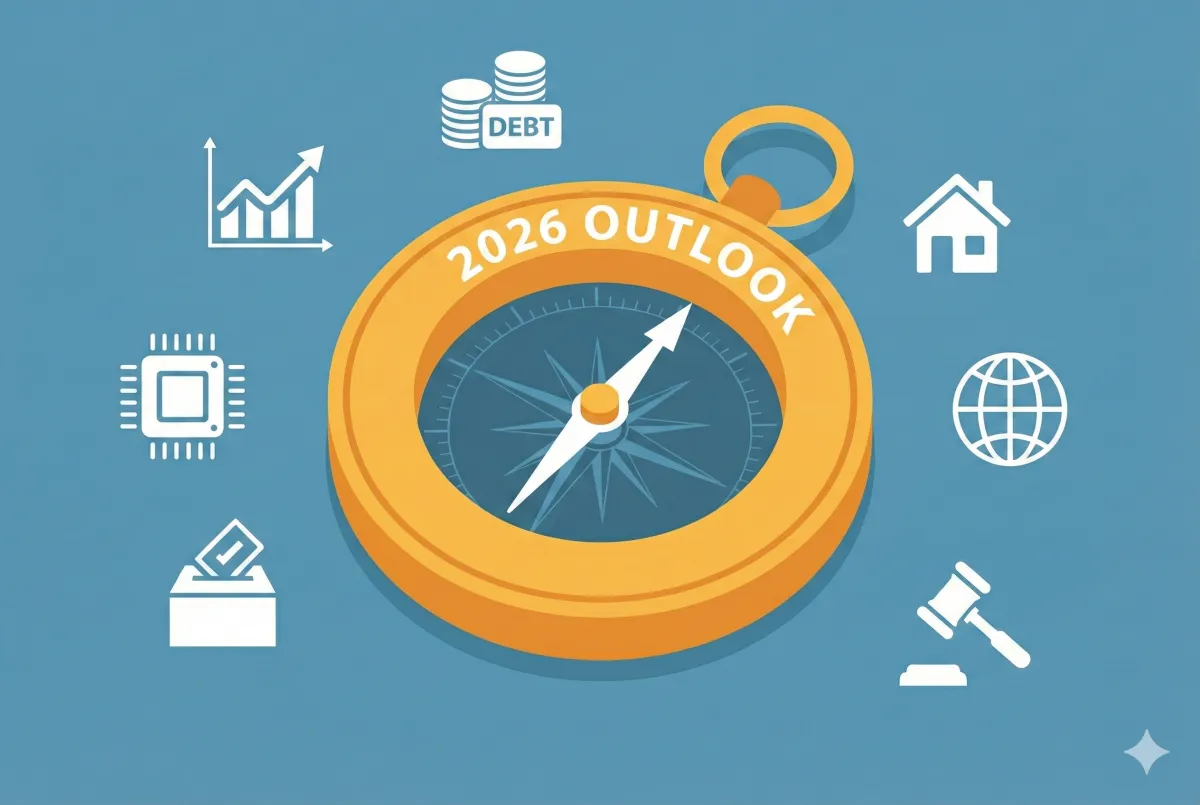
Navigating 2026: 7 Key Themes for Your Retirement Journey
For the sixth time in the last seven years, the stock market is on track to deliver double-digit returns. That is a truly remarkable streak. If you’ve been watching your account balances grow, you’re likely feeling a sense of relief and perhaps a bit of pride—and you should! These returns are fantastic news for your financial "house" and the security of your retirement.
But if you’re like many of the folks I sit down with every day, there’s another feeling creeping in alongside the happiness: nervousness.
It’s often said that the anticipation of something is greater than the thing itself. We spend years hoping for strong returns to secure our future. But once we get them—and see markets hitting all-time highs—we start waiting for the other shoe to drop. We worry about "giving it back."
As we look toward 2026, I want to help you replace that worry with perspective. In 2025, we saw inflation stabilize around 3%, the Federal Reserve continued to cut rates, and despite fears of a recession since 2022, the economy kept growing.
The most important lesson here? The things we fear most often don't actually happen. History shows us that for every true market storm, there are dozens of false alarms that never materialize.
Our job isn't to predict the future—it's to build a portfolio that can weather whatever the future holds. Here are seven key themes I’m watching for 2026, and what they mean for your retirement plan.
1. Your Portfolio Has More Than One Engine
For a long time, U.S. stocks were the only game in town. But as we head into 2026, we are seeing a welcome shift. International stocks are picking up steam, and bonds are doing exactly what we need them to do: providing stability.
This is why we diversify. Think of your portfolio like a well-balanced meal. You don't just eat dessert (high-growth stocks); you need protein and vegetables (bonds and international stocks) to stay healthy. High-quality bonds have gained about 7% this year, acting as a shock absorber against volatility. When one part of your portfolio zigs, another zags, helping to smooth out the ride.

2. Prices Are High, But Fundamentals Are Strong
You might hear chatter in the news that the stock market is "expensive." They are referring to valuations—essentially, how much you have to pay to buy a dollar of a company's future earnings. Right now, the S&P 500 is trading at levels we haven't seen since the dot-com era.
Does this mean a crash is imminent? Not necessarily. High prices alone don't cause crashes. Unlike the dot-com bubble, where companies had no profits, today's companies are earning real money. However, high valuations do suggest that future returns might be more modest. It means we shouldn't expect 20% gains every single year. It’s a signal to stay balanced and not get greedy.

3. The AI Revolution: Tool or Bubble?
Artificial Intelligence (AI) is the buzzword of the decade. Companies are spending trillions on data centers and chips. It reminds me a bit of the railroad boom of the 1860s—massive investment that eventually transformed the economy, but not without some bumps along the way.
For us, AI is exciting, but it also creates concentration risk. A huge chunk of the S&P 500 is now driven by just a handful of tech companies. If you own an index fund, you own a lot of AI, whether you realize it or not.
My advice? Let’s make sure your financial future isn't bet entirely on one sector. We want to participate in the growth, but we also want a "moat" around your nest egg to protect it if the tech sector takes a breather.

4. The Economy: Growing, But Changing
The economy is still growing, which is great news. But it’s becoming a "two-speed" economy. Some sectors (like tech) are zooming ahead, while others are moving slower.
One key to long-term health is productivity—how much we can get done in an hour of work. We’re hoping AI will boost this, but it takes time. For you, the takeaway is that while the headline numbers look good, we need to remain vigilant about things like consumer debt that could slow things down.

5. Tariffs: More Bark Than Bite?
Tariffs were a major headline in 2025, but interestingly, the sky didn't fall. Inflation didn't spike as much as feared. Companies adjusted, and consumers kept spending.
Tariffs are a tool the government uses for policy goals. They aren't going away, but we’re learning that they are just one variable in a complex global economy. We shouldn't overhaul your long-term plan based on a trade policy that might change with the next election cycle.

6. Elections and the National Debt
2026 brings the midterm elections. Historically, markets actually do quite well in midterm years. But the elephant in the room is the national debt, now hovering around $36 trillion.
I know that number is scary. It’s staggering. But here is the hard truth: Investing based on fear of the national debt has been a losing strategy for decades. If you had stayed out of the market because of debt concerns in 2010, you would have missed out on incredible growth.
Control what you can control. We can't fix the national debt, but we can optimize your taxes. With recent changes in tax legislation (like the OBBBA), now is the perfect time to review your tax strategy to ensure you aren't tipping the IRS more than necessary.

7. The Fed is Changing Guard
Finally, keep an eye on interest rates. The Federal Reserve has been cutting rates, which helps borrowers. But with Chair Jerome Powell’s term ending in May 2026, we will see new leadership.
Don't get too caught up in trying to predict the Fed's next move. Whether rates go up or down a quarter of a point doesn't change your retirement goals. We focus on the long term—on ensuring your income lasts as long as you do.

The Bottom Line for 2026
As we head into the new year, you’re going to see a lot of scary headlines. You’ll hear about debt, elections, and bubbles.
Remember this: Your plan was built for this.
We didn't build your financial house assuming sunny weather every single day. We built it with a strong foundation and a weatherproof roof so you can stay warm and dry regardless of the storm outside.
So, take a deep breath. Enjoy the gains you’ve made. And let’s keep our eyes on the horizon, not the waves crashing at our feet.


