Navigating Financial Storms: Why Your Reaction to Volatility Matters
Navigating Financial Storms: Why Your Reaction to Volatility Matters
If you’ve been watching the stock market lately, you might be feeling a little anxious. When the market plunges, it is completely natural to feel uneasy and tempted to make seemingly safe decisions that pull you away from your long-term plan. But I want to share a story that illustrates why keeping a level head and a long-term perspective is so critical.
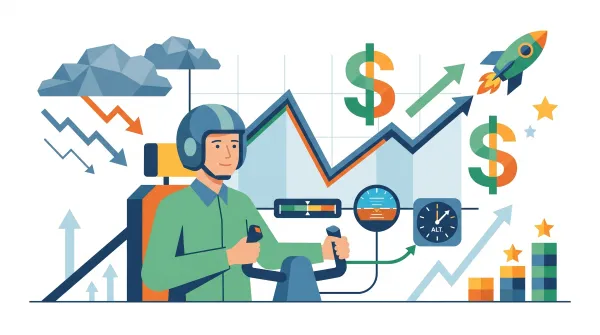
Back in 1991, researchers at the University of Illinois put 20 pilots into a flight simulator.
These pilots were trained to fly using visual flight rules, meaning they only flew when conditions were clear enough to see the ground and other aircraft.
They didn't know how to rely on their flight instruments.
When the researchers simulated poor visual conditions, every single one of those 20 pilots crashed.
The average time it took them to crash was just 178 seconds.
However, the researchers then gave these pilots two hours of training on how to use their flight instruments. After that training, all of the pilots were able to fly successfully.
Navigating periods of stock market volatility is very similar. Without historical perspective, a diving stock market can tempt you to make decisions that could hurt your long-term investment results. Getting out of the market when things look scary can seem very tempting, but just like those pilots, making moves when you can't see clearly can lead to poor outcomes. Your historical perspective is your instrument panel.
The Tale of Two Investors
Let's look at how two very different reactions to volatility played out between 1986 and 2025. Imagine two investors who both started with $10,000 invested in the S&P 500 Index on December 31, 1985. They both faced the exact same market drops, but they took opposing approaches.
The apprehensive investor panicked every time the stock market dropped 8% or more in a month, moving $2,000 into 30-Day US T-Bills, which are often viewed as safe, conservative investments.
The opportunistic investor did the exact opposite, choosing to invest an additional $2,000 into the Index every time the market dropped 8% or more in a month.
The apprehensive investor was able to avoid some of the market's short-term effects, but eventually, their assets were completely invested in cash. Because of this, they completely missed the significant growth experienced by the market. By 2025, their balance was just $76,563.
The opportunistic investor chose to not only tolerate but take advantage of the volatility. By seeing the drops as a chance to buy, their ending balance was a staggering $1,462,186. That is a difference of $1,385,623, all based on how they reacted to the exact same financial storms.
Expecting the Unexpected
It is completely natural to desire consistent returns. However, short-term volatility isn't just expected, it can also be an investment-growth opportunity. For example, from 1986 through year-end 2025, the S&P 500 Index had an average annual return of 11.47%. Yet, it only actually returned between 9% and 12% in three of those years. The rest of the time, it fluctuated above or below that average, sometimes significantly.
We have to remember that despite the growth potential of equities, market drops are going to happen, and they can be uncomfortable.
Between 1986 and 2025, there have been seven bear markets.
Historically, the probability of a bear market occurring is only about one in every five and a half years.
Five of those recent bear markets were less than a year long.
The average decline during these periods was 35%.
But what's more important than what happens during these bear markets is what happens after they occur. At the end of 1985, the S&P 500 Index was at 211. By the end of 2025, it closed at 6,845. That is more than 32 times higher than it was when our two hypothetical investors started.
When the stock market gets rough, remember to look at short-term volatility from a long-term perspective. Viewing volatility as an opportunity instead of purely a threat can lead to far different results. If you ever feel the urge to panic, please remember that you don't have to fly without instruments. Talking to your financial professional before making big decisions can help you keep your perspective and safely navigate the storm.


