Navigating Geopolitical Storms: What the Latest Middle East Headlines Mean for Your Retirement
When you turn on the news lately, it's hard not to feel a little anxious. As you have seen in the news, the U.S. and Israel have launched strikes against Iran, targeting leadership, military assets, and nuclear infrastructure. Iran has retaliated with attacks across the Middle East. The situation continues to evolve, and the safety of civilians in the region and our troops remains the most important consideration.
These events involve real human consequences and are unlike typical market news about earnings and economic data. It's natural to feel uneasy when headlines describe military strikes and the possibility of a wider regional war. But how does a geopolitical storm like this affect the financial house we've built for your retirement?
I believe it’s important to look at the financial market implications to provide perspective on what this means for markets, oil prices, and your portfolio.
The Impact on Oil and the Markets
For investors, the most direct way that Middle East conflicts affect financial markets is through oil prices and global trade. Iran sits along the Strait of Hormuz, the world's most critical energy waterway.
Here is what we are seeing right now:
Following the strikes, oil prices increased, pushing stocks and bonds slightly lower.
This is consistent with other Middle East conflicts, where oil price spikes are often a primary driver of market moves.
However, perspective is needed; current oil prices remain far below the 2022 peak of nearly $128 per barrel when Russia invaded Ukraine.
The U.S. is also now the world's largest producer of oil and natural gas. While the U.S. still relies on global energy markets, this level of production helps insulate the domestic economy from supply disruptions.
It's also important to note that Iran plays a minimal direct role in most investment portfolios. The country has been under heavy sanctions for years, limiting its participation in global financial markets.
Protecting Your Financial House
The process of building a portfolio and creating financial plans is designed precisely to manage this uncertainty. While the scale of the current strikes is significant, tensions between the U.S., Israel, and Iran have been escalating for some time. This is the latest chapter in an ongoing story.
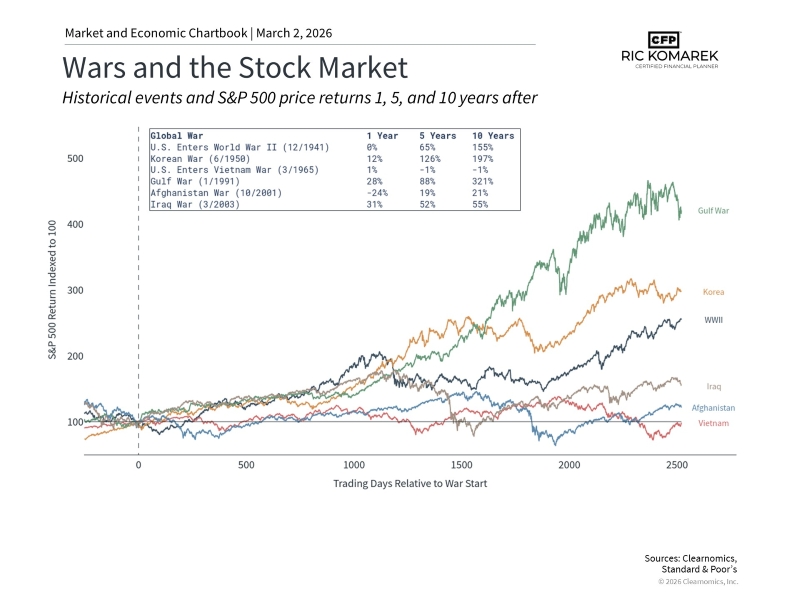
Looking from a broader perspective, from World War II to the Gulf War, markets often experienced short-term volatility but were driven by economic fundamentals over the long run. More recently, conflicts between Russia and Ukraine, and between Israel and Hamas, created uncertainty but did not derail the long-term market trajectory.
For long-term investors, the most important lesson from past geopolitical conflicts is the value of staying invested. Making dramatic portfolio changes in response to geopolitical events can be counterproductive. The key for long-term investors is to separate headlines from portfolio decisions.
This doesn't mean markets won't experience volatility in the coming days and weeks. Uncertainty around the duration and scope of the conflict could weigh on investor sentiment, but markets can rebound quickly and unexpectedly.
Think of your retirement strategy as a well-built house with a strong foundation. We designed it to weather these exact types of storms. I am watching the situation carefully and will keep you informed if anything material changes regarding your portfolio.
I am here to help, so please don’t hesitate to reach out if you have any questions.


