Navigating Market Swings: Why Your Financial House is Built for This
It is hard to ignore the headlines lately. Between the ongoing conflict in the Middle East, stock market swings, and Brent crude oil climbing back above $110 per barrel, you might be feeling a bit of whiplash. These headlines naturally raise questions about whether higher energy costs could slow down the economy and push inflation back up. Throw in concerns about the path of interest rates and market valuations, and it is easy to see why investors might feel anxious.
When markets experience these kinds of swings, there is often a strong temptation to adjust your portfolio to react to the perceived uncertainty. Especially when you are in or nearing retirement, the fear of losing what you've worked so hard to build is completely understandable.
However, a key principle of proper financial planning is that by the time these unpredictable events strike, the hard work has already been done. Think of your retirement plan as a sturdy financial house. A well-constructed portfolio is the strong foundation, designed specifically to weather different types of economic storms without needing constant renovations every time the wind blows.
Still, markets that lack a clear direction can feel uncomfortable. In times like these, it is more important than ever to not lose sight of your long-term goals. Here is some perspective I hope brings you a bit of peace of mind.
Market Pullbacks Are a Normal Part of Investing
The stock market has been undeniably choppy recently, with the S&P 500 experiencing its first pullback of 5% or worse this year.
Perspective is key: It is crucial to remember that pullbacks of this size are completely normal.
History provides comfort: Just look back at last year, in 2025. We saw six different pullbacks of 5% or more for the S&P 500, driven primarily by tariff concerns. Despite those regular drops, the market still generated a solid 16% return for the year.
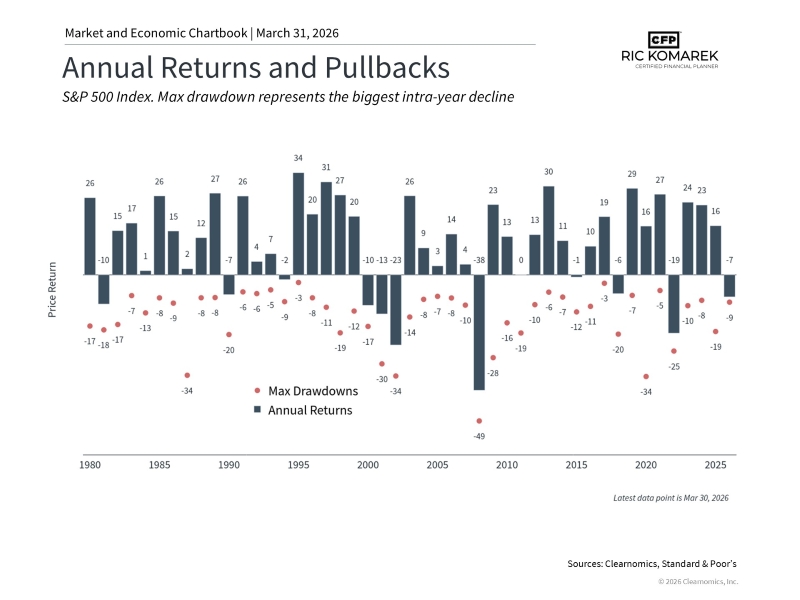
This historical resilience is the exact reason why staying invested is usually the best approach. While it is tempting to try and time the market by jumping out when things look bad, doing so requires you to be right twice: you have to know exactly when to get out, and exactly when to get back in. The market's best days often happen shortly after its worst days. Investors who step to the sidelines usually miss the very rebounds they were waiting for, putting a dent in their long-term security.
The Reality of Higher Gas Prices
While the stock market grabs the headlines, the most direct way global conflicts affect our everyday lives is right at the gas pump. The national average for regular unleaded climbed to $4.00 per gallon by the end of March, jumping more than a dollar in just a month.
Filling up the car is a non-negotiable expense. It is unpleasant, and it leaves less money in your pocket for the fun parts of retirement. It also has indirect effects: transportation, agriculture, and manufacturing all rely on energy, meaning higher fuel costs can nudge the price of everyday goods higher across the board.
But let's put this into context:
We've been here before: Financial markets and the economy overcame very similar challenges in 2022, when gas hit a record high of $5.00 per gallon. Portfolios still performed very well over the following years once the market recovered.
This isn't the 1970s: It is easy to draw comparisons to the Arab oil embargo, which brought long lines and rationing. Today's situation is fundamentally different because the U.S. is now the world's largest oil and natural gas producer.
Takeaways for Your Peace of Mind
The past few weeks highlight exactly why we focus so heavily on achieving proper portfolio balance. Right now, assets like commodities and energy sectors are leading the way. The goal isn't to guess what will outperform next month. Instead, it is about holding a balanced mix of investments so that when one part of your portfolio struggles, another part is there to provide support and stability.
Your portfolio is designed precisely to navigate environments just like this one. History consistently shows that making dramatic, emotional changes to your investments in response to geopolitical events is often counterproductive to your long-term security.
I am monitoring the situation carefully, as always. In the meantime, please don't hesitate to reach out if you have any questions or if you just want to talk through what these headlines mean for your specific financial plan. I'm always here to help.


