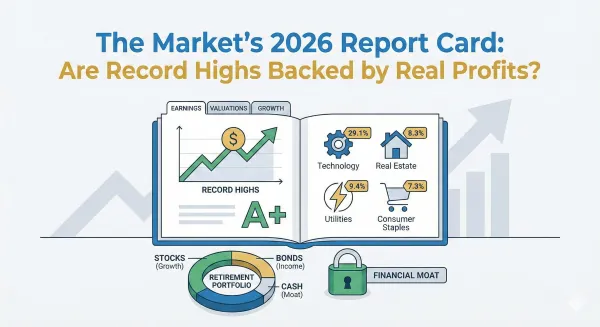
Understanding the Market’s "Report Card": Why Earnings Matter for Your Retirement
I often hear from folks who are understandably a bit nervous when the stock market hits new highs. It’s a bit like watching a house you’ve meticulously built over decades continue to rise in value—it’s exciting, but you can’t help but wonder if the foundation is still solid.
Right now, as we move through January 2026, the S&P 500 is sitting near record levels. But prices alone don’t tell the whole story. To understand if the market’s growth is sustainable for your retirement plan, we have to look at earnings—essentially the "report card" for corporate America.
The Fuel in the Tank
Think of corporate earnings as the fuel that drives the stock market "car" forward. Over the long haul, stock prices tend to follow where profits lead. If you look back at the last 35 years, the connection is clear: when companies make more money, their stock prices generally go up.

As of late January 2026, the "fuel tank" looks quite full. Here’s a quick look at where we stand:
The Market Price: The S&P 500 recently reached 6,916.
The Profits: Earnings-per-share (or EPS, which is just the portion of a company’s profit allocated to each outstanding share of stock) hit $271.
The Growth: We’ve seen 10 consecutive quarters of growth, with profits rising about 13% over the last year.
For your retirement portfolio, this is reassuring news. It means the market’s rise isn't just based on "hot air" or speculation; it’s backed by the fact that businesses are actually becoming more profitable.
Is the Price Tag Too High?
While earnings are the fuel, valuations tell us how much we are paying for that fuel. We often measure this using the Price-to-Earnings (P/E) ratio. Think of this like the price tag on a gallon of milk. If the historical average price is $3.00, but today it’s $4.50, you’re paying a premium.

Currently, the market’s "price tag" (the forward P/E ratio) is 22.2x. To put that in perspective:
The Historical Average: 15.9x.
The Tech Bubble Peak (2000): 24.5x.
We are definitely in "expensive" territory. When prices are high relative to earnings, there is a smaller margin for error. This doesn't mean a crash is imminent, but it does mean that if companies hit a "pothole" and earnings don't meet expectations, the market could experience some bumps or volatility. For someone in retirement, this is why we focus so much on having a "financial moat"—a buffer of safer assets—so you aren't forced to sell stocks when they are temporarily "on sale."
Where is the Growth Coming From?
Not all sectors of the economy are moving at the same speed. Right now, the "engine" of the market is clearly the Technology sector.

Tech Sector Growth: Expected to grow by a whopping 29.1%.
Energy and Consumer Staples: Growing much more slowly, at around 5% to 7%.
Much of this Tech growth is fueled by massive investments in Artificial Intelligence (AI). Companies are spending billions to build the "infrastructure" of the future. While this is exciting, I always remind my clients that we don't want to put all our eggs in one basket. Tech might be the fastest horse in the race today, but a well-balanced retirement plan needs a variety of "players"—like Healthcare and Utilities—to provide stability when the high-fliers take a breather.
My Bottom Line for You
As a retiree, it’s easy to get caught up in the daily "noise" of the financial news. My advice? Focus on the foundation of your "financial house."
Strong earnings are a great sign that the economy is vibrant, but high valuations mean we need to remain disciplined. We don’t chase the "shiny new thing" just because it’s up 30%. Instead, we ensure your portfolio is built to weather different seasons, keeping enough cash and fixed interest on hand so you can enjoy your retirement with peace of mind, regardless of what next quarter’s "report card" says.


