Why Record Markets and Higher Rates Are Actually Good News for Your Retirement
As the calendar turns toward autumn, it is natural to reflect on where things stand—especially when the financial headlines seem to contradict each other.
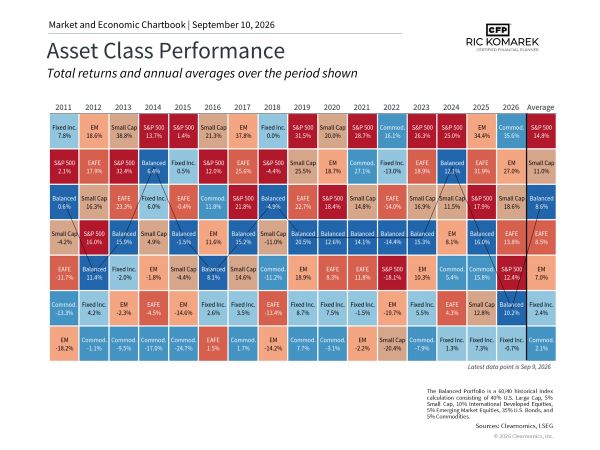
Right now, the broad stock market is hovering near all-time highs. At the same time, interest rates sit at levels we haven't experienced in roughly two decades.
Conventional wisdom suggests high borrowing costs put the brakes on economic growth and weigh down share prices. So why are both moving higher together, and what does that mean for your nest egg?
A resilient financial house relies on different pillars carrying weight at different times. When built properly, an apparent contradiction in the markets can actually work in your favor.
The Engine Driving Stocks Forward
Market growth this year hasn't been driven by mere speculation. It is primarily powered by strong corporate earnings—the actual profits businesses generate after paying expenses.
Over extended horizons, equity prices tend to follow earnings trends. When underlying businesses expand their profitability, stock values generally reflect that strength.
A few key factors are providing support today:
Broad sector strength: Gains are distributed across energy, domestic industrials, and technology rather than resting on a single category.
Profit resilience: Projections point toward corporate earnings expanding significantly above long-term historical averages.
Economic confidence: Higher borrowing costs today reflect real economic activity rather than sudden inflationary panics.
The Silver Lining Behind Bond Yields
If your stock holdings have climbed while your bond values remained largely flat, you might wonder whether your fixed income is pulling its weight.
Bond prices and interest rates naturally move in opposite directions. When rates rise, existing bond values temporarily pause. However, that trade-off comes with an essential upside: yield.
Meaningful income: High-quality government and corporate bonds offer income streams we simply didn't see during the near-zero rate environment of the past decade.
Capital preservation: Fixed income provides a vital cushion against sharp equity pullbacks, moderating overall volatility.
Reinvestment power: As older bonds mature, those funds can be reinvested into higher-yielding opportunities.
Think of fixed income as the protective moat around your financial house. Its primary assignment isn't to outpace stock gains; it exists to supply steady income and safeguard your foundation when equity markets face turbulent weather.
Staying Grounded in Your Plan
Market cycles inevitably bring surprises, and temporary dips are an ordinary part of the journey. Attempting to jump in and out of the market to avoid short-term swings often creates unnecessary tax burdens and locks in losses.
When each asset class performs its designated role—equities capturing long-term growth and fixed income providing dependable yield—your portfolio remains balanced and positioned to support your retirement lifestyle.
How comfortable are you that your current income plan can absorb the next inevitable market shift without forcing you to change your everyday spending?
If you are within five years of retiring or newly retired, you are navigating what is known as the retirement red zone—the critical window where mistakes carry the greatest cost. For a deeper look at protecting your assets during this phase, feel free to pick up a copy of The Retirement Red Zone, or reach out directly to review your personalized strategy.


